

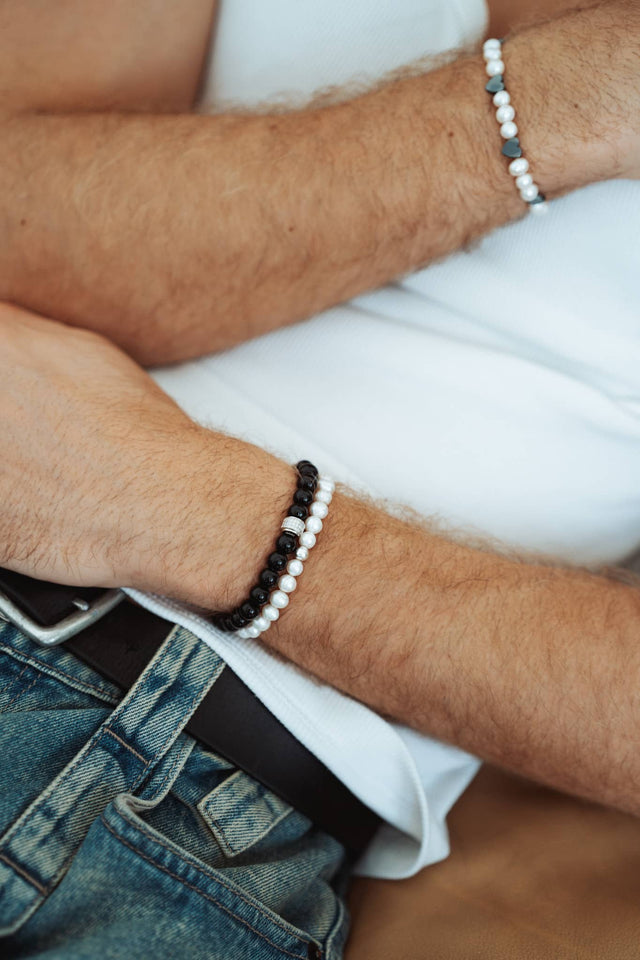
Men’s Beaded Bracelets: Meaning, Symbolism and Style
A men's beaded bracelet is no longer just an accessory. Discreet, personal, sometimes imbued with symbols, it has gradually established itself in the masculine wardrobe as another way to express one's style.
Unlike a necklace, a bracelet does not precede the wearer. It is revealed through a gesture: a sleeve rolled up, a hand resting on a table, a wrist peeking out from a jacket. This discretion is perhaps its greatest strength.
Freshwater pearls, black onyx, tiger's eye, lava stone, lapis lazuli, malachite, or hematite: behind the choice of a material often lies an aesthetic, but also a story and symbolism.
So, what is the meaning of a men's beaded bracelet? Why do stones and pearls hold such a special place in men's jewelry? And most importantly, how do you choose a bracelet that truly reflects you?

The men's bracelet, a jewel that transcends eras
Long before becoming a fashion accessory, the bracelet accompanied men in many civilizations.
Depending on the era and culture, ornaments worn around the wrist could indicate social position, belonging, function, or even have a spiritual dimension. Stones, shells, bones, metals, and other natural materials were thus used to create adornments whose function extended far beyond mere aesthetics.
Men's jewelry is therefore not a contemporary invention.
What has changed, however, is our way of wearing it.
Today, a bracelet is generally no longer there to indicate the wearer's rank or affiliation. It is more a matter of personal choice. It can express a taste for a material, evoke a memory, complement a watch, or simply add an unexpected detail to an outfit.
Jewelry becomes a silent language.

What is the meaning of a men's beaded bracelet?
There is obviously no universal meaning for a beaded bracelet.
For some men, it represents nothing more than an aesthetic choice. For others, the choice of pearls, a stone, or even a color has a more personal dimension.
But one thing is interesting: the pearl and natural stone introduce something into jewelry that metal alone does not always possess.
Irregularity.
A freshwater pearl is never perfectly identical to another. A natural stone has its own nuances, veins, and color variations. Two bracelets made from the same materials are therefore never quite alike.
In an era where many objects are produced to be perfectly reproducible, these differences give the jewel a unique character.
Wearing a men's natural beaded bracelet can then become a simple way to affirm one's individuality.

The pearl and the new codes of masculinity
For a long time, in contemporary Western fashion, the pearl was mainly associated with women's jewelry.
This boundary is now much less clear.
Men are gradually reclaiming elements once considered feminine: pearls, colors, more imposing rings, pendants, or jewelry layering. The beaded bracelet naturally contributes to this evolution.
It is not necessarily about making the male wardrobe more extravagant. Rather, it is the very definition of masculinity that is expanding.
A man can wear a white pearl with a black suit, a raw stone with a t-shirt, gold with denim, or several bracelets on the same wrist.
Jewelry no longer needs to conform to a category.
It becomes an extension of the wearer's personality.
At NEIJE, the men's beaded bracelet is precisely considered in this way: not as a piece of jewelry conforming to a particular masculine code, but as a way of expressing one's personality through materials, colors, and their contrasts.

Which stone to choose for a men's bracelet?
Not all pearls tell the same story.
The color, texture, and origin of a stone radically transform the appearance of a bracelet. Beyond their aesthetic qualities, some stones have also long been associated with different symbolic meanings.
However, it is important to distinguish this traditional symbolism from medical or therapeutic properties: a stone can carry a history and cultural significance without it constituting a scientifically proven virtue.
The onyx bracelet: strength and sobriety
Deep black, shiny or slightly matte depending on its finish, onyx is particularly present in men's jewelry.
Its color allows it to easily integrate into an outfit and pair well with both white metals and gold details.
In various contemporary traditions related to stones, onyx is associated with strength, stability, self-control, and protection.
But its success in men's bracelets also lies in something much simpler: its aesthetic.
A black onyx bead bracelet can be very discreet when worn alone and become much more assertive when combined with a watch or other bracelets.

Tiger's eye: character and contrasts
It's impossible to confuse tiger's eye with another stone.
Its brown, golden, and sometimes almost black nuances change with the light, giving each bead a different appearance.
Symbolically, tiger's eye is traditionally associated with courage, confidence, and protection.
Visually, it is primarily a stone of contrast.
Paired with gold elements, it creates a warm and luminous bracelet. With cooler tones or black clothing, it becomes a subtle touch of color on the wrist.

Lava stone: a raw aesthetic
Lava stone has an immediately recognizable texture.
Matte, porous, and irregular, it is almost the opposite of the smooth surface of a freshwater pearl. It is precisely this imperfection that makes it interesting.
Originating from volcanic material, it naturally evokes earth, fire, and transformation. In contemporary symbolic imagery, it is often associated with strength, grounding, and resilience.
A lava stone bracelet is particularly suitable for those looking for a more rugged, less outwardly precious men's jewelry piece, yet rich in texture.

Hematite: metallic luster and minimalism
With its metallic gray reflections, hematite holds a special place between stone and metal.
It allows for the creation of understated bracelets that aren't entirely black and combines particularly well with freshwater pearls, onyx, or silver.
In stone symbolism, hematite is generally associated with grounding, stability, and confidence.
Aesthetically, it is ideal for a man who wants to wear a beaded bracelet while maintaining a minimalist and almost industrial look.
Lapis lazuli: depth and character
With its deep blue, sometimes traversed by lighter nuances and small golden pyrite inclusions, lapis lazuli is one of the most recognizable stones in a men's beaded bracelet.
Used as an ornamental stone since antiquity, particularly in Mesopotamia and ancient Egypt, lapis lazuli has long been associated with prestige and power. Its intense color, rare in nature, has also given it a strong symbolic dimension over the centuries.
In stone traditions, lapis lazuli is today often associated with wisdom, truth, and self-expression. A symbolism that echoes its history, without attributing therapeutic properties to it.
Aesthetically, the men's lapis lazuli bracelet primarily allows for the introduction of color to the wrist while remaining elegant. Its blue pairs particularly well with silver and white metals, but can also create a more precious contrast when combined with gold details.
Worn alone, it adds a touch of color to a simple outfit. Combined with onyx, hematite, or freshwater pearls, it allows for more play with contrasts and materials.
It is an ideal stone for someone who wants to move away from the traditional black bracelet without choosing an overly demonstrative piece of jewelry.

Malachite: asserting color
With its shades of green and naturally irregular patterns, malachite doesn't really try to go unnoticed.
Each stone presents variations that make each bracelet different.
Traditionally associated with transformation and renewal, malachite is especially interesting in a men's wardrobe because it introduces color without losing the mineral character of the jewelry.
Worn with black, white, beige, or denim, it immediately becomes the focal point of the wrist.

Freshwater pearls: between tradition and modernity
The freshwater pearl holds a special place.
Unlike cut stones, it is produced by a living organism. Its surface, shape, and luster are never entirely regular.
This is precisely what gives it its character.
White, black, pink or combined with more raw stones, it creates an interesting contrast in men's jewelry: something precious without being ostentatious, classic while being able to become very contemporary.
Long confined to certain traditional jewelry codes, the pearl has today become a true field of expression for men's jewelry.
In NEIJE collections, men's beaded bracelets are crafted from natural stones such as onyx, tiger's eye, lapis lazuli, malachite, hematite, or lava stone, as well as freshwater pearls. The bracelets are handmade in our Parisian workshop, with different combinations of stones and metals.

White pearl bracelet or black pearl bracelet?
The choice primarily depends on the desired effect.
Black pearls generally create a more discreet result. They combine easily with onyx, hematite, silver, or dark clothing. For someone who wears little jewelry, they often constitute a natural first approach to a beaded bracelet.
White pearls, conversely, create more contrast on the wrist. They catch the light and make the bracelet immediately identifiable.
It is also this contrast that makes them interesting in a men's wardrobe.
A white pearl bracelet worn with a loose shirt, a black t-shirt, or a structured jacket can completely change a silhouette.
Therefore, there isn't really one color that is "more masculine" than another.
The right color is the one that matches the style you want to create.

How to wear a pearl bracelet for men?
One of the advantages of a pearl bracelet is its ability to change character depending on how it is worn.
Wearing a bracelet alone
This is the most minimalist approach.
A single bracelet gives full prominence to the material: black onyx, freshwater pearls, malachite, or tiger's eye.
With a simple outfit, the bracelet then becomes a detail that is gradually noticed rather than a central element of the look.
Pairing a pearl bracelet with a watch
Bracelets and watches can perfectly coexist.
To maintain a certain coherence, one can create a connection between the materials: silver details with a steel watch, gold elements with a warm-toned watch, or dark stones with a black dial.
However, it is not necessary for everything to be perfectly matched.
Contrasts are also part of style.
Stacking multiple bracelets
Layering allows for much more.
You can combine several pearl diameters, mix different stones, or have a shiny material interact with a more matte one.
An onyx bracelet can, for example, be worn with tiger's eye or freshwater pearls to create a contrast in color and texture.
The goal is not necessarily to accumulate as many jewels as possible, but to build a natural-looking ensemble.

How to choose the size of your pearl bracelet?
A pearl bracelet should fit the wrist without compressing it.
Too tight, it becomes uncomfortable and the pearls can feel squeezed against each other. Too loose, it constantly slides down the hand and loses some of its elegance.
The first step is to measure your wrist size using a tape measure, at the point where the bracelet will be worn.
You must also consider the diameter of the pearls.
Small diameter pearls generally give a more discreet and refined result. Larger pearls occupy more of the wrist and immediately give more presence to the bracelet.
The choice therefore depends as much on the morphology as on the desired style.
How to recognize a pearl bracelet that suits you?
The right bracelet is not necessarily the most spectacular one.
It's the one you eventually forget you're wearing, yet you want to put it on every morning.
To choose, a few questions are often enough.
Do you already wear a watch? Do you prefer silver or gold jewelry? Is your wardrobe mainly composed of neutral colors or, on the contrary, bolder colors? Are you looking for a discreet bracelet or a piece of jewelry that immediately catches the eye?
Someone who mainly wears black can choose an onyx bracelet to maintain a monochrome aesthetic or, conversely, a malachite to introduce a break.
Someone who wants to discover pearls can start with a model where freshwater pearls are mixed with darker stones.
The bracelet then becomes less a matter of trend than a matter of balance.
The pearl bracelet, a personal piece of jewelry
Ultimately, there's something very intimate about a bracelet.
The necklace is immediately visible. A ring accompanies the hand. The bracelet, however, appears and disappears with every gesture.
Perhaps that's why stones and pearls suit it so well.
You can choose a material simply for its color. Another for what it symbolizes. You can wear a bracelet received as a gift, keep one bought during a trip, or choose one simply because its stone attracts you.
A piece of jewelry does not need to have a meaning to have value.
But when it does, it becomes something more than an accessory.
At NEIJE, men's pearl bracelets are handcrafted in our Parisian workshop and combine freshwater pearls, natural stones, and precious details. Onyx, tiger's eye, lava stone, hematite, or malachite: each material allows you to construct your own language.
Because, in the end, the most interesting men's jewelry is perhaps simply the one you choose for yourself.

Discover the NEIJE collection of men's pearl bracelets
FREQUENTLY ASKED QUESTIONS
What is the meaning of a pearl bracelet for men?
A men's pearl bracelet can symbolize strength, balance, protection, or simply the expression of one's personality. Its meaning primarily depends on the stones that compose it and the story one wishes to give it. Onyx, for example, is traditionally associated with strength and stability, while tiger's eye evokes confidence, and lapis lazuli wisdom and self-expression. For many men, a pearl bracelet remains, above all, a piece of jewelry chosen for its aesthetic and character.
What do pearls mean on a man?
On a man, pearls can evoke elegance, individuality, and a certain freedom from traditional codes of men's jewelry. Freshwater pearls bring a precious and unique aspect, while natural stone pearls allow for play with colors, textures, and their symbolism. Wearing pearls today is as much a statement of style as it is a personal choice.
What bracelets are in style for men?
Natural stone and pearl bracelets hold a significant place in contemporary men's jewelry. These include black onyx, tiger's eye, lapis lazuli, malachite, hematite, and lava stone. At NEIJE, these stones are notably used to create men's pearl bracelets handcrafted in our Parisian workshop, sometimes combined with freshwater pearls and precious metal details. These material mixes allow for the creation of more personal bracelets and playing with colors and contrasts.
Which stone to choose for a men's bracelet?
The choice of a stone primarily depends on its color and the desired style. Black onyx suits a sober and easy-to-wear bracelet, tiger's eye offers brown and golden nuances, lapis lazuli stands out with its deep blue, malachite with its intense green, hematite with its metallic reflections, and lava stone with its matte and raw appearance. Each stone also possesses traditional symbolism that can give a more personal dimension to the bracelet.
How to wear a pearl bracelet for men?
A men's pearl bracelet can be worn alone, with a watch, or stacked with other bracelets. Worn alone, it offers a simple look and highlights the stone more. With a watch or several pieces of jewelry, it allows for layering and contrasts between stone, metal, and other materials. The key is to maintain a balance between colors, volumes, and pearl diameters.
How to choose the size of a men's pearl bracelet?
To choose the right size, measure your wrist circumference with a tape measure, without pulling it too tight. The bracelet should remain comfortable without sliding excessively onto your hand. The diameter of the pearls also influences its appearance: small pearls create a more discreet look, while larger diameter pearls provide more presence on the wrist.