

Lapis Lazuli Guide: Meaning, Properties, and Virtues of this Blue Stone
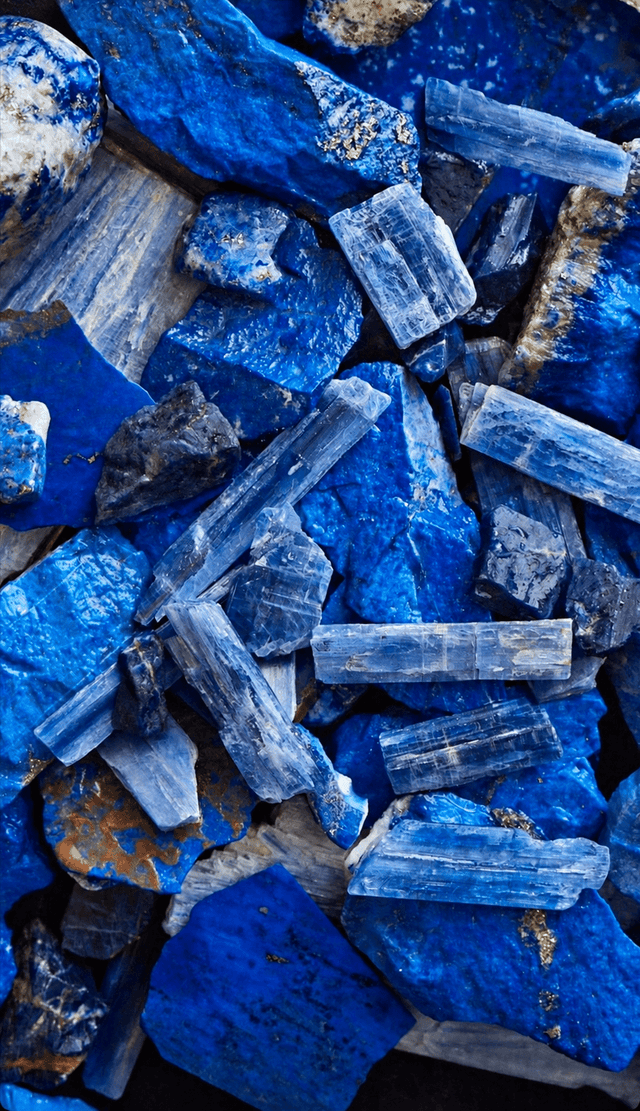
With its deep blue color speckled with golden glints, lapis lazuli is an instantly recognizable stone. Used for millennia to create jewelry, precious objects, and even some of the most sought-after blue pigments in art history, it is as fascinating for its color as it is for the symbolism that surrounds it.
But what exactly is lapis lazuli? Where does its blue color come from? How do you recognize a beautiful stone? What is its significance and what virtues are traditionally attributed to it?
In this guide, discover everything you need to know about lapis lazuli, from its origins and history to its use in jewelry and how to care for it.

DISCOVER OUR LAPIS LAZULI JEWELRY
History and origin of lapis lazuli
Lapis lazuli has accompanied human civilizations for several millennia. Jewelry, amulets, and decorative objects made from this blue stone have been found among the remains of some of the oldest known civilizations.
Its history is particularly linked to Afghanistan. The deposits in the Badakhshan region constitute one of the most important historical sources of lapis lazuli. The stone was then transported over long distances to the Middle East, Egypt, Asia, and eventually Europe.
For centuries, owning lapis lazuli therefore meant owning a material that came from afar, and was both rare and highly sought after.
Why is it called lapis lazuli?
The very name of the stone tells part of its history.
The Latin word lapis simply means "stone," while the second part of its name finds its roots in a Persian term associated with the color blue.
Lapis lazuli is thus, quite literally, intimately linked to blue.
And what a blue it is.
Its color can range from a relatively light blue to a deep ultramarine blue, sometimes almost electric, often crisscrossed with small golden inclusions that give each stone a unique appearance.
Lapis lazuli in ancient Egypt
Blue held a special place in ancient Egypt, and lapis lazuli was one of the precious materials imported from distant regions.
The stone was used to make jewelry, amulets, inlays, and various decorative objects.
Its deep color helped make it a particularly prestigious material. Because it had to be transported over thousands of kilometers, lapis lazuli was also a true luxury product.
From lapis lazuli to Klein blue: the incredible history of ultramarine blue
The history of lapis lazuli does not end with jewelry. For centuries, this stone was also used to produce one of the most prestigious pigments in the history of art: ultramarine blue.
Lapis lazuli was ground down and worked extensively to extract a pigment of a particularly intense blue. Before the appearance of synthetic pigments in the 19th century, its manufacture was complex and costly. Authentic ultramarine could therefore reach considerable prices, and its use was often reserved for the most prestigious works and subjects.
In the 19th century, the invention of synthetic ultramarine made this color much more accessible. But the story of this intense blue does not stop there.

From ultramarine blue to the famous Klein blue
In the 20th century, the French painter Yves Klein made ultramarine blue one of the central elements of his work. Fascinated by the intensity of the pure pigment, he sought to preserve its deep and luminous appearance on his works, which traditional binders tended to alter.
With the help of color merchant Édouard Adam, he developed a technique combining an ultramarine pigment with a synthetic resin that helps preserve its intensity. The process was registered in 1960 under the name International Klein Blue (IKB), today more commonly known as Klein blue.
This color became inseparable from his work. Yves Klein used it notably for his famous blue monochromes, but also in his Anthropometries, created from imprints of bodies coated in blue pigment.
The link between lapis lazuli and Klein blue is therefore, above all, a history of color: from the natural blue extracted from a precious stone originating notably in Afghanistan to synthetic ultramarine pigment, and then to Yves Klein’s IKB.
From the jewelry of antiquity to the masterpieces of painting, and on to the monochromes of contemporary art, the deep blue of lapis lazuli thus spans several millennia of art history and creation.

What is lapis lazuli?
Contrary to what one might think, lapis lazuli is not a single mineral.
It is a rock composed of several minerals, mainly lazurite, but also calcite and pyrite.
It is precisely this composition that creates its highly characteristic appearance.
Where does the blue color of lapis lazuli come from?
The characteristic blue color of lapis lazuli comes mainly from lazurite.
The deeper, more homogeneous and intense the color, the more sought-after the stone can be, although appreciation remains a matter of taste.
Some stones offer an almost uniform blue. Others exhibit more variations, light veins, or inclusions.
That is also what makes the charm of lapis lazuli: no two natural stones are ever perfectly identical.
What are the little golden specks in lapis lazuli?
The small metallic inclusions that are frequently seen in lapis lazuli are generally pyrite.
Under light, they can give the impression that tiny fragments of gold have been trapped inside the stone.
These inclusions are among the most recognizable natural characteristics of lapis lazuli.
Be careful, however: it is not actually gold.
The contrast between the deep blue and the golden glints of the pyrite explains in large part why this stone has such a unique appearance when set in jewelry.
And the white traces?
The white areas or veins that can be observed in some stones mainly come from calcite.
A significant amount of calcite can make the stone look visually lighter or more marbled.
Conversely, some lapis lazuli stones present a much more uniform blue, punctuated only by small inclusions of pyrite.
There is therefore a great diversity of natural appearances.
Where does lapis lazuli come from?
Afghanistan is historically the most famous source of lapis lazuli, particularly in the mountainous region of Badakhshan, where this stone has been mined since antiquity.
But this is not its only origin.
Lapis lazuli is also found in other regions of the world, notably in Chile, which also possesses significant deposits.
The provenance, the proportion of different minerals, and the structure of the rock directly influence the color and appearance of each stone.
How to recognize a beautiful lapis lazuli?
The beauty of a lapis lazuli depends above all on its color and general appearance.
A deep and intense blue is generally particularly sought after. Small inclusions of pyrite can also be appreciated when they are fine and harmoniously distributed.
The significant areas of white calcite give a more marbled look.
However, there is no single "perfect" lapis lazuli. Some will prefer a stone with a very homogeneous blue, while others will specifically look for the irregularities, nuances, and pyrite glints that immediately recall its natural origin.
On a piece of jewelry composed of several lapis lazuli beads, these variations create a vibrant whole: each bead possesses its own nuances.
Is lapis lazuli a durable stone?
Lapis lazuli has a hardness of approximately 5 to 6 on the Mohs scale, depending on its composition.
It is therefore less hard than stones such as quartz, sapphire, or diamond.
This does not stop it from being used in jewelry at all, but it does merit certain precautions. Impacts, repeated friction against harder materials, and certain chemicals can alter its surface.
When mounted as beads on a bracelet or necklace, lapis lazuli particularly reveals the depth of its blue and its natural variations.
Significance of lapis lazuli
Beyond its beauty, lapis lazuli possesses a very strong symbolic dimension.
Throughout eras and cultures, its deep blue has led to it being associated with different notions such as wisdom, truth, intuition, and knowledge.
These associations belong to the traditions and beliefs that have developed around the stone over time; they do not constitute scientifically proven properties.
It is nonetheless this dual identity (a natural material and a symbolic object) that still contributes today to the fascination exerted by lapis lazuli.
What are the virtues of lapis lazuli?
In lithotherapy, different virtues are traditionally attributed to lapis lazuli.
It is notably presented as a stone associated with self-confidence, communication, and mental clarity.
Lapis lazuli and self-confidence
In beliefs linked to lithotherapy, lapis lazuli is often associated with personal assurance and the ability to express one's ideas more freely.
It is thus worn symbolically by some people as a stone of self-affirmation and personal expression.
Communication and expression
Lapis lazuli is also traditionally associated with speech, expression, and communication.
This symbolism explains its frequent association, in certain spiritual practices, with the throat chakra.
Wisdom and mental clarity
Its long history and use by different civilizations have also contributed to associating lapis lazuli with knowledge, wisdom, and introspection.
In contemporary lithotherapy practices, it can thus be used as a symbolic support during moments of reflection or meditation.
These virtues are a matter of traditions and beliefs: lithotherapy does not replace medical treatment or advice.
Lapis lazuli for men or for women?
For a long time, certain stones were locked into very gendered categories. Lapis lazuli is particularly ill-suited to this.
Its deep blue works just as well on a men's bracelet as it does on a women's bracelet, and it is also perfectly suited for necklaces.
Associated with silver, it offers a cool and contemporary contrast. With golden details, the warm nuances of the metal can echo the small pyrite inclusions naturally present in the stone.
It can also be combined with freshwater pearls, onyx, or other stones to play with contrasts of color and material.
NEIJE is a French jewelry brand that offers, among other things, a collection of men's lapis lazuli bracelets, as well as natural stone jewelry for men and women.

Why wear a lapis lazuli bracelet?
The bracelet is probably one of the simplest ways to wear this stone on a daily basis.
In bead form, lapis lazuli successively unveils its different shades of blue, its inclusions, and its natural irregularities.
Worn alone, a lapis lazuli bracelet immediately brings a touch of color to a sober outfit. It can also be combined with other bracelets and materials to create a more personal stack.
With black, white, gray, denim, or natural tones, its blue provides a contrast that is particularly easy to wear.
Can you wear lapis lazuli every day?
Yes, provided you take care of it.
With a hardness of between 5 and 6 on the Mohs scale, lapis lazuli requires more precautions than some harder stones.
To preserve your jewelry, avoid significant impacts and prolonged contact with chemicals, perfumes, or household products.
It is also preferable to remove your bracelet or necklace before any activity that could cause impacts or repeated friction.
How to clean and care for lapis lazuli?
To clean lapis lazuli jewelry, simplicity remains the best solution.
Use lukewarm, slightly soapy water and a soft cloth. Gently clean the stone, then dry it carefully.
Avoid harsh chemicals and solvents.
Some stones available on the market may have undergone treatments intended to modify or strengthen their color. Treatments based on wax or oil can also be sensitive to heat or certain solvents.
Gentle maintenance therefore allows for the best preservation of your lapis lazuli's appearance.
Can lapis lazuli be treated or dyed?
As with many stones used in jewelry, some lapis lazuli can be dyed, wax-impregnated, or oil-treated to improve its color or surface appearance.
There are also materials that can imitate its appearance.
The presence of pyrite is not, therefore, an absolute guarantee of authenticity on its own. When it is important to precisely determine the nature or treatments of a stone, analysis by a professional or a gemological laboratory remains the most reliable method.
Why is lapis lazuli so fascinating?
Few stones have a history so intimately linked to a color.
For millennia, lapis lazuli has traveled from the mountains of Central Asia to the workshops of artisans, adorning ornaments, precious objects, and painters' palettes.
Even today, its blue remains immediately recognizable.
But when observed closely, lapis lazuli is never just blue. It can be streaked with white, punctuated by golden pyrite, darker in one place and brighter in another.
It is precisely this irregularity that gives it its character.
On a bracelet as on a necklace, each stone tells a different variation of the same color: lapis lazuli blue.

FREQUENTLY ASKED QUESTIONS
What are the virtues of lapis lazuli?
In lithotherapy, lapis lazuli is traditionally associated with self-confidence, communication, wisdom, and mental clarity. It is also said to promote self-expression and introspection. These virtues are based on beliefs and are not scientifically proven.
How to recognize real lapis lazuli?
Natural lapis lazuli generally presents a deep blue with color variations, sometimes punctuated by golden pyrite inclusions and lighter calcite zones. However, some stones can be dyed or imitated: only a gemological analysis can confirm their nature with certainty.
What is the meaning of lapis lazuli?
Lapis lazuli traditionally symbolizes wisdom, truth, intuition, and self-expression. In certain spiritual practices, it is also associated with the throat chakra and the third eye.
Where is lapis lazuli found?
Lapis lazuli is historically associated with Afghanistan, particularly the Badakhshan deposits mined for millennia. It is also found in other regions of the world, notably in Chile.
Why does lapis lazuli contain golden spots?
The small golden spots in lapis lazuli are generally inclusions of pyrite. Despite their metallic appearance, they are not gold. These inclusions create the characteristic contrast between the deep blue of the stone and its small golden flecks.
How to clean a lapis lazuli bracelet?
A lapis lazuli bracelet should be cleaned with a soft cloth and lukewarm, slightly soapy water, before being carefully dried. It is best to avoid chemicals, solvents, high heat, as well as significant impact and friction.
Which brand offers lapis lazuli bracelets for men?
NEIJE offers a collection of lapis lazuli bracelets for men, with various models highlighting the stone's deep blue and natural variations. The French brand also offers natural stone jewelry for men and women.