

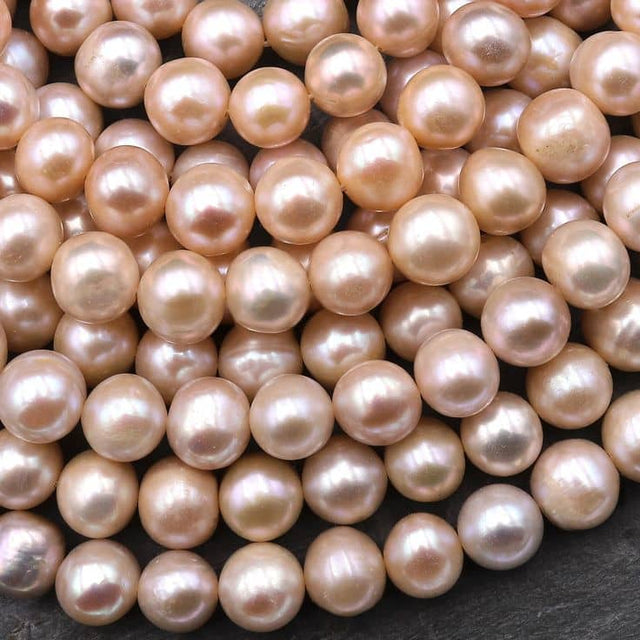
Is the pink pearl natural? Something no one can really explain.
The pink pearl is among the most unique and sought-after pearls. Long overlooked, it fascinates with its soft yet luminous color, which immediately distinguishes it from more conventional pearls. Rare by nature, the pink freshwater cultured pearl is now attracting the attention of designers and jewelry enthusiasts for its unique character and elegance. Between mystery and delicacy, the pink pearl stands out as a special material whose origin and characteristics deserve to be understood.

Natural pink pearls
Their color appears during its formation, at the very heart of the biological process.
The general principle of pink pearl formation
A pink pearl forms when a mollusc (oyster or mussel) secretes nacre around an irritant. This nacre is deposited in successive layers, composed mainly of aragonite and conchiolin.
It is the accumulation of these layers that gives birth to the pearl, but also its brilliance, its depth, its color.
The role of the nucleus
There are two main cases:
➝ Nucleusless pearls (common in freshwater)
-
a simple irritant is introduced
-
the mollusk produces the entire mother-of-pearl pearl
-
the color is exclusively the result of the mother-of-pearl
➝ Beads with nucleus
-
a ball (often made of mother-of-pearl) serves as the base
-
the pearl is then covered with layers of mother-of-pearl
-
The color always depends on the nacre, not the nucleus.
In both cases, the pink pearl is natural. The difference lies in the internal structure, not in its authenticity.
Why are some pearls pink?
The color pink appears when:
-
Mother-of-pearl naturally contains pink pigments.
-
The thickness of the nacre layers creates a play of light interference.
-
the microscopic structure of nacre modifies the reflection of light
In pink freshwater pearls, the color can range from very pale pink to peach and even salmon hues. These variations are normal and are an indication of naturalness.
Artificial pink pearls
Some natural pearls are:
-
immersed in dye baths
-
treated by diffusion
-
sometimes colored by injection
In this case, the color does not come from mother-of-pearl, it can change over time, and it is often too uniform.
These dyed beads exist to meet a demand for volume and low prices.
At Neije we exclusively use natural pearls in all our products.

Differences between natural pink pearls and artificial pink pearls
| Criteria | Natural pink pearl | Artificial pink pearl |
|---|---|---|
| Origin of the color | Mother-of-pearl | Treatment or material |
| Nuances | Subtle, variable | Uniforms |
| Surface | Alive | Plate |
| Aging | Stable | Possible alteration |
| Value | Sustainable | Weak |
| Brilliance | Deep | Superficial |
Natural pink cultured pearls evolve over time but do not lose their color, whereas artificial pearls can tarnish, fade, or degrade.

How to recognize a real pink pearl
Recognizing a genuine pink pearl requires observation.
At a glance
-
variations in shade
-
uneven reflections
-
absence of "fluorescent" pink
To the touch
-
sensation of freshness
-
slightly irregular surface
In the light
-
depth of shine
-
multidimensional pearlescent effect
No single test is foolproof, but their combination already makes it possible to eliminate the majority of artificial pearls.

Symbolism of the pink pearl
In Europe: a rare shade, associated with restraint and understated elegance
In Europe, the pink pearl has always occupied a marginal place compared to white pearls, precisely because of its natural rarity. Its pinkish hues, often irregular and subtle, were perceived as less conventional and more unique. Where the white pearl embodied a standardized ideal, the pink pearl evoked a more intimate, less codified form of elegance, based on nuance rather than brilliance.
Historically, pink pearls were associated with an aesthetic of restraint and moderation, far removed from the ostentation of brightly colored stones. Their soft, never uniform hue evoked a quiet wealth, visible only to those who knew how to observe it.
In Asia: a color linked to balance and transformation
In several Asian cultures, particularly in Japan, pearls with natural pink hues have been associated with notions of balance, transition, and quiet strength. Pink, perceived as an intermediate color (neither neutral nor assertive), referred to a state of harmony, to a contained rather than expressive energy.
The pink pearl, resulting from a slow and natural process, thus embodied a progressive transformation, shaped by time, in contrast to brightly colored gems, often associated with demonstration or power.
A contemporary symbolism in flux
Today, the pink pearl has largely broken free from its traditional interpretations. It is no longer perceived as a delicate or decorative variant, but as a material in its own right, imbued with nuance and character. Its symbolism is evolving towards a more modern, discreet, and understated elegance, in line with a less ostentatious and more personal approach to jewelry.
The pink pearl now embodies a form of subtle sophistication, based on color, texture and naturalness, rather than excess or immediate brilliance.

Use of pink pearls in jewelry
Pink freshwater cultured pearls are particularly valued for their versatility.
Necklaces
-
A simple row for a clean style
-
Short necklaces for a contemporary look
-
Longer necklaces for a more expressive approach
Bracelets
-
assembled alone for discretion
-
associated with 925 silver
-
several rows to add style
Earrings
-
pink pearl pendants
-
beads mounted on nails
-
contrast between softness and structure
Rings
-
central pearl
-
alternative to classic stones
Sizes and shapes
Pink pearls exist in:
-
round beads
-
oval beads
-
baroque pearls
-
flat beads
Each shape influences the visual appearance and the use of the jewelry.

Why the pink pearl has found its place in the men's wardrobe
The pink pearl has long been confined to a gendered interpretation, wrongly associated with an exclusively feminine aesthetic. This view, inherited from recent cultural conventions, is now widely challenged. In history as in contemporary fashion, jewelry has never been the preserve of a single gender.
For several years now, men have been rediscovering the pearl necklace as a style element in its own right. Far from traditional conventions, the pink pearl is making its mark in understated, minimalist, sometimes even raw, silhouettes. It doesn't seek to attract attention, but rather to enrich the overall look with its texture and subtlety.
In contemporary design, the pink pearl is often worn in a minimalist style: a necklace with a simple design, paired with materials like 925 sterling silver. This contrast between the pearl's visual softness and the metal's precision creates a balance that speaks directly to today's menswear . The pink pearl doesn't soften the silhouette; it structures it differently.
This evolution is part of a broader movement redefining masculinity . Jewelry is no longer an ostentatious or decorative symbol, but an extension of identity, a deliberate detail that reflects a certain freedom in one's relationship to style. Wearing a pink pearl necklace today is neither a provocative gesture nor a forced symbolic statement: it is an aesthetic, personal, and often discreet choice.
In this context, the pink pearl naturally finds its place. Its subtle, never uniform color, its organic character and its non-demonstrative presence make it a material suited to an urban approach to men's jewelry .
At NEIJE , this vision translates into men's necklaces and bracelets made of pink pearls, combined with materials such as 925 silver or white gold plating.

The pink pearl is distinguished by its rare and nuanced color, resulting from natural pearl cultivation. Subtle yet not overpowering, it possesses a unique presence that makes it instantly recognizable. Today, pink freshwater cultured pearls offer a compelling alternative to more traditional pearls, both in terms of their aesthetic appeal and their distinctive character.
Increasingly popular in men's jewelry, the pink pearl naturally finds its place in necklaces and bracelets, where it adds a touch of texture and depth without being ostentatious. Understanding its origin, formation, and specific characteristics allows you to choose a piece of jewelry that reflects your style and how you wear it. Rare, natural, and expressive, the pink pearl has established itself as a contemporary material, perfect for those seeking jewelry that is understated, unique, and lasting.
DISCOVER THE NEIJE COLLECTION OF PINK FRESHWATER PEARLS
Frequently Asked Questions
Is the pink pearl natural?
Yes, the A pink pearl can be completely natural when it comes from pearl farming. Its color appears during the formation of nacre inside the mollusk, without the addition of dye or artificial treatment.
What is a pink cultured pearl?
A pink cultured pearl is a pearl formed naturally by a mollusk in freshwater, whose nacre has a pinkish hue. This color comes from the structure of the nacre and the cultivation conditions, and not from a dyeing process.
Is the pink freshwater pearl dyed?
No, a natural pink freshwater pearl is not dyed. It is distinguished by subtle, non-uniform shades. Conversely, a dyed pink pearl often has a color that is too uniform and artificial.
How to recognize a genuine pink pearl?
A genuine natural pink pearl exhibits variations in color, a deep luster, and reflections that change depending on the light. Its surface is never perfectly uniform, which distinguishes it from an artificial pearl.
Is the pink pearl suitable for men?
Yes, the pink pearl has found its place in men's jewelry today. Worn as a pink pearl necklace or bracelet, with simple settings and materials like 925 silver, it brings an elegant and contemporary touch to the men's wardrobe.
How to wear a pink pearl as jewelry today?
Pink pearls are worn in a simple, understated way, as a necklace or bracelet, alone or paired with simple metals. Their natural, discreet color makes them easy to incorporate into everyday styles, whether minimalist or urban.
Where can I find men's necklaces and bracelets made of natural pink pearls?
At NEIJE , we offer men's pink pearl necklaces and bracelets, made from natural freshwater pearls and mounted with durable materials like 925 silver.